
What Craig County Property Tax Records Show
Craig County splits the work cleanly. The Commissioner of Revenue maintains real-estate ownership records, assessments, and relief programs. The Treasurer collects county and state taxes and runs the inquiry and payment services. Screen labels on the live parcel card and tax inquiry can vary, so treat the table here as a map to the source rather than a promise of every field. Keep three entries distinct in your mind: a value, a charge, and a payment. Each one answers a different question about the same parcel.
| Field | What It Shows | Where |
|---|---|---|
| Real-estate assessment | Value and ownership records maintained for county assessment | Commissioner of Revenue |
| Tax ticket | Real-estate bill lookup by bill or parcel number | Treasurer e-Services |
| Payment history | Real-estate account inquiry and prior payment history | Treasurer e-Services |
| Yearly taxes paid | Inquiry by year; the full coverage range is not published | Treasurer e-Services |
| Relief application | Annual forms for elderly or disabled owners and disabled veterans | Commissioner of Revenue |
One caveat on timing. Craig County finished a countywide reassessment in 2023, per a local report. But the Commissioner publishes no town-level value trend and no guaranteed interval for roll updates. An assessed figure and a deed's stated consideration are two different observations. So compare them only with that in mind. The tax bill reflects the rate and the account's own details. It does not tell you what the property would sell for. And it is no substitute for an appraisal.
Craig County's 2023 Reassessment Is a Snapshot
A report in the New Castle Record says Wampler-Enes Appraisal Group completed Craig County's reassessment in 2023. Treat that as a dated event, not a running market series. The Commissioner of Revenue keeps the assessment and ownership records. The official page posts no next reassessment date, and no parcel-level annual change table. It also states no lag between a closing and a roll update. Check the parcel's current record with the Commissioner. Do that before relying on any figure in a property decision.
For context, set three numbers side by side. Take the county's assessed value, the deed's recorded consideration, and the Treasurer's tax bill. They can differ. They answer different questions. The Craig County property value explanation separates assessed value from sale price. The tax account shows charges and payment history rather than a market appraisal.
Craig County e-Services Tracks Real-Estate Tickets
The Treasurer's e-Services page offers real-estate tax inquiry and payment. Payment history is there too. It also totals real-estate taxes paid each year. The landing page says a bill can be located by Department/Bill Number or Parcel Number. Prepayment lookup may use a parcel number or a name. A card payment carries a 3% convenience fee. A search or history inquiry is a separate use of the account site. It stands apart from a payment itself.
Craig County Treasurer e-Services lists the real-estate account options, shown in the screenshot. Use the parcel key to avoid mixing up similarly named accounts. If a year or bill is missing, ask the Treasurer directly.
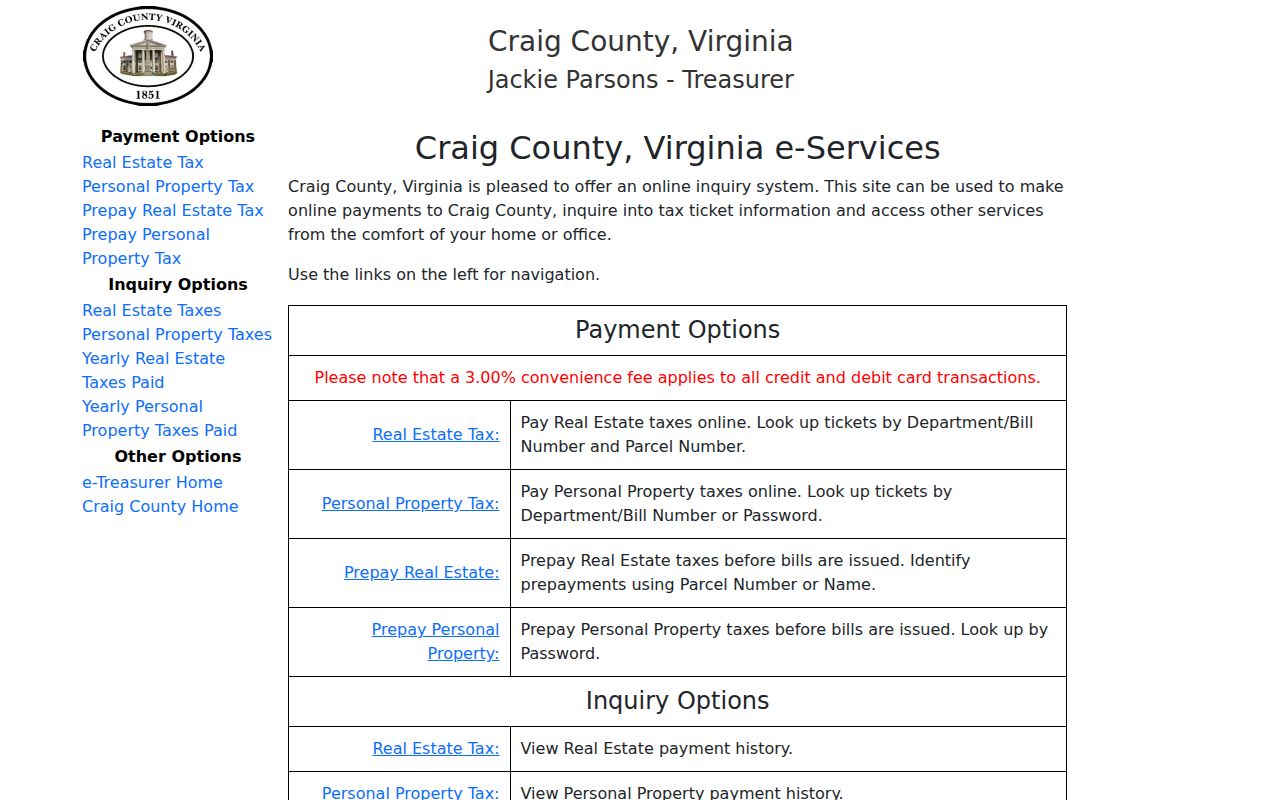
The account view helps with payment research. Still, the Treasurer remains the source for any balance that cannot be reconciled online.
Looking Up a Craig County Tax Bill
Start with the tax parcel number when you have it. The Treasurer's page describes lookup by Department/Bill Number or Parcel Number, while a prepayment inquiry may use a parcel or owner name. A street address is not listed as a guaranteed search key. Copy the bill number and department exactly from any paper notice, or pull the parcel identifier from WebGIS or the Commissioner. Live result fields can change. A blank response does not prove that no account or charge exists.
- Open Craig County Treasurer e-Services and choose the real-estate inquiry or payment route.
- Search by Department/Bill Number or Parcel Number; prepayment lookup may use parcel or owner name.
- Review the bill and payment history, then ask the Treasurer about any missing year or balance.
- Check Commissioner relief information separately and confirm recorded liens or transfers with the Clerk.
- Assessment
- The value assigned for county tax purposes by the Commissioner.
- Tax rate
- The county charge applied per $100 of assessed real-estate value.
- Tax ticket
- The Treasurer's account showing an amount billed and payment status.
- Tax lien
- A recorded or legal claim tied to unpaid taxes; confirm both the account and land records.
Keep the billing year attached to any amount you record. The portal offers payment history and yearly taxes paid. That helps separate an installment still due from a prior payment. If a balance looks inconsistent, let the Treasurer confirm it. Card payment adds a 3% convenience fee. A search is separate from completing a payment. Any payment record should be tied to the correct parcel or bill before it enters a property file.
Craig County Tax Dates and the 2026 Rate
Craig County real-estate taxes are paid in two installments, due June 5 and December 5. Bills go out in the last week of April and the first week of October. The 2026 county real-estate rate is $0.56 per $100 of assessed value. Give the Treasurer any change in mailing address. An escrow change can affect who receives the bill. If a notice never arrives, use the parcel number or call the Treasurer. Do not assume no tax account exists.
The real-estate inquiry endpoint is listed by the county. The form can be slow to load at times. The endpoint marks where an account inquiry begins. Do not read it as a confirmed field layout. Do not read it as proof of a specific payment result.
To estimate a charge, multiply the county rate by the assessed figure. The Treasurer confirms the final bill. That office sits at 182 Main Street in New Castle. It keeps weekday hours of 8:30 a.m. to 4:30 p.m. It takes calls at 540-864-5641.
Bills go out in spring and fall. A mailing-address change or an escrow switch can interrupt delivery, but the account itself stays open. When asking about a missed notice, a payment missing from the online record, or a prior year's ticket, have the parcel number or bill number ready. The Treasurer can then pull the right account.
Craig County Tax Relief Uses Annual Forms
The Commissioner of Revenue runs the county's tax-relief programs. For 2026, the office posted applications for elderly or disabled relief and for disabled veterans. The elderly and disabled form set March 2, 2026 as the filing date. Relief is granted annually, and application details stay confidential. That deadline has passed, and the office has not yet posted the next filing date. The disabled-veteran affidavit requires a 100% permanent total service-connected disability and a primary residence. Use the current county forms, and ask the Commissioner which supporting records to include.
Relief can change a taxable bill. It does not change the deed or set a new market value. Never assume an exemption carries over automatically. A parcel may be owner-occupied, or a past bill may have shown a reduction. The Commissioner can confirm the assessment-side record. The Treasurer can explain how the current ticket reflects it.
Craig County Delinquency Requires a Treasurer Check
The county tax page posts installment dates. It publishes no delinquent-property list or tax-sale calendar. For a particular Craig County parcel, ask the Treasurer about the ticket, payment status, penalties, interest, and any referral for legal action or sale. The Clerk's land records show the other half of the picture: a recorded lien, notice, trustee deed, or completed conveyance. A tax account and a land-record index run in parallel. Neither substitutes for the other.
The county's tax-bill reprint route is part of Treasurer e-Services. The live form fields are not always available, so treat that page as the doorway to the reprint service rather than a sample bill.
A payment record and a recorded transfer do not always match. Give both offices the parcel number and instrument reference so each can check its own files.
Ask Craig County About an Assessment Review
The Commissioner of the Revenue assesses property and assists taxpayers. The county's accessible pages publish no current appeal calendar or board sequence. No filing deadline or evidence list appears either. Do not apply a generic Virginia timeline to a Craig County parcel. Ask the Commissioner which review step fits the current assessment. Ask what documents the office accepts. Ask when a request must arrive. Keep a copy of the parcel record, recent comparable deeds, and any notice received. That paperwork helps the office identify the valuation in question.
A tax bill and a value dispute are related but separate matters. The Treasurer explains what is due and whether a payment posted. The Commissioner handles assessment and relief questions. A recorded sale can offer useful context. Its stated consideration does not fix the assessed value for another year or parcel.
The Commissioner's office is at 182 Main Street, Suite 3, New Castle. Weekday hours run 8:30 a.m. to 4:30 p.m., and the number is 540-864-6241. Bring or send the parcel number. Bring the notice or assessment year. Bring the value being questioned. The county's pages do not state which review board or deadline applies. Confirm the current process before assembling an appeal packet or relying on an older form.
Confirm the current process. Craig County's public pages do not state the current appeal deadline or review board steps. Contact the Commissioner of Revenue before relying on an old notice or form.