
Tracing Former Owners in Craig County
Start from the newest recorded deed for the parcel. Read the grantee name. Then hunt down the instrument that shows how that same party first acquired the property in Craig County. Whoever signed as grantor on the older deed is your prior owner of record. Repeat the process, deed by deed. The chain of title grows backward one transfer at a time.
Search both the grantor and grantee indexes as you go. Names in Craig County deed records may be shortened or misspelled. A single pass under one spelling can break the chain. No official source gives a firm cutoff for the online records. That makes the historical finding aid the essential tool for picking the next record series to search.
| Source | Years It Covers | Where Held | What It Shows |
|---|---|---|---|
| SRA/COVERS land index | Online start year not stated | Circuit Court Clerk / Virginia Courts | Party and instrument references where enabled |
| Grantor and grantee indexes | 1851-1912 | Library of Virginia microfilm | Earlier transfer parties |
| Craig deed books B-K | 1851 onward in surviving volumes | Clerk and LVA reels | Recorded instruments, including early re-recordings |
| Plat Book | 1851-1932, pages 3-74 | Library of Virginia finding aid | Lot, block, road, and subdivision clues |
| Judgment-lien dockets | 1878-1967 | Library of Virginia microfilm | Parallel claims affecting land |
A recent transfer points to SRA/COVERS and the Clerk. For a nineteenth-century chain, use the LVA grantor and grantee indexes first. Then pull the referenced deed books and plats. The tract may predate Craig County's 1851 formation. If so, search the parent county's deed records as well. The county publishes no reliable starting year for online images. Former-owner work should not stop at a portal's oldest result.
Craig County Grantor Indexes Reach 1912
The Library of Virginia publishes a finding aid. Its catalog lists general grantor and grantee deed indexes for Craig County. Together they cover 1851 through 1912. The catalog is a route to microfilm reels, not a modern owner database. Nor does it show how far back the current online index reaches. Search both sides of each conveyance. A name appears as grantee when acquiring land and later as grantor when selling it. Match the property description and book reference, not just the person.
The LVA Craig County finding aid lists the index and plat series. It also notes a general will index for 1850 to 1893. That series carries a mistaken label as an index to deeds. The odd catalog entry matters when an estate transfer interrupts the apparent chain. Check it before assuming a link is missing.
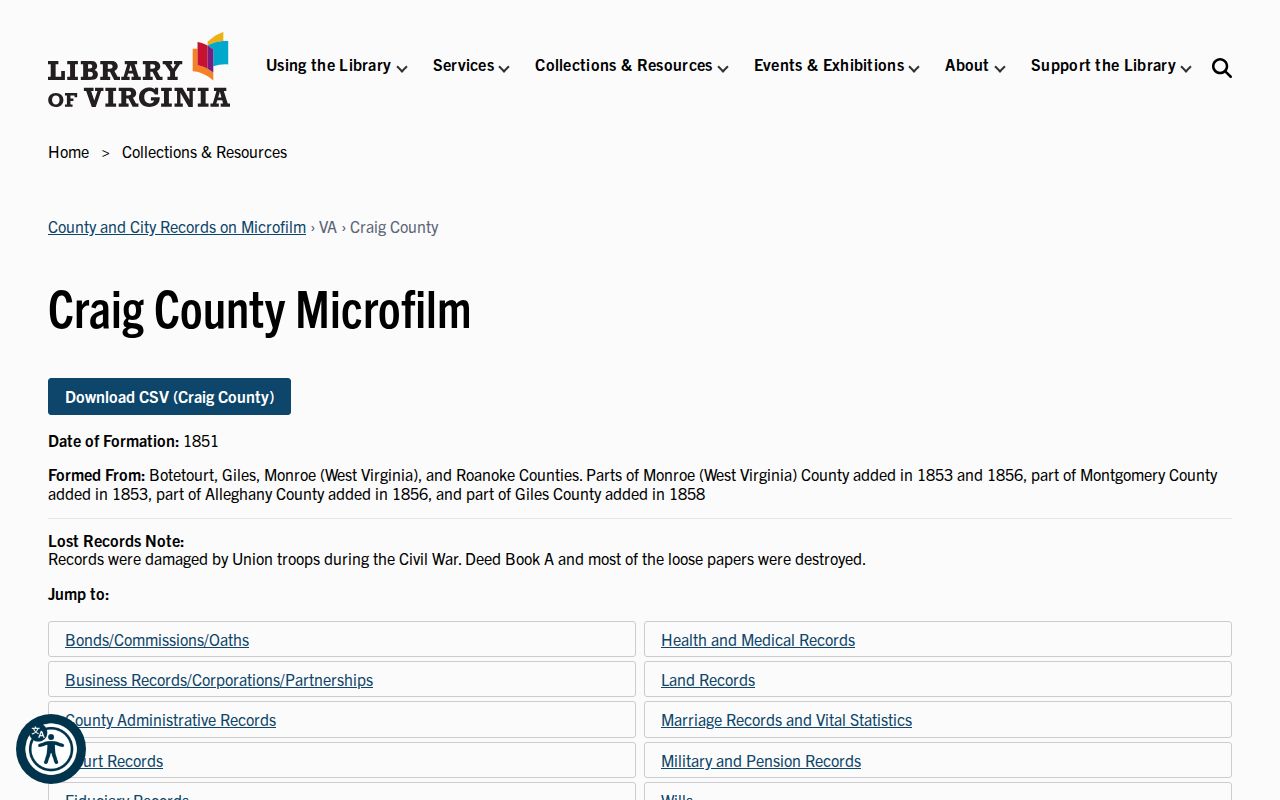
Use the listed date span to plan the next source. Verify the reel's own index and volume before citing any predecessor as owner of record.
Craig County's Missing Book A Changes the Search
Union General David Hunter passed through Craig County in 1864. Early courthouse records were damaged or destroyed in the wake. The Library of Virginia reports that Deed Book A and most loose papers did not survive. Book B survives. It begins in 1864. It holds re-recorded deeds reaching back to the county's founding in 1851. Book C preserves some early re-recordings too. Owners from before the loss may still appear in those copied instruments. They may also appear in plats, court orders, tax books, and probate files.
Craig County's official history page describes the record loss at the courthouse. When a chain seems to stop at Book A, treat that as a signal. Hunt for re-recordings. Never assume no earlier owner existed.
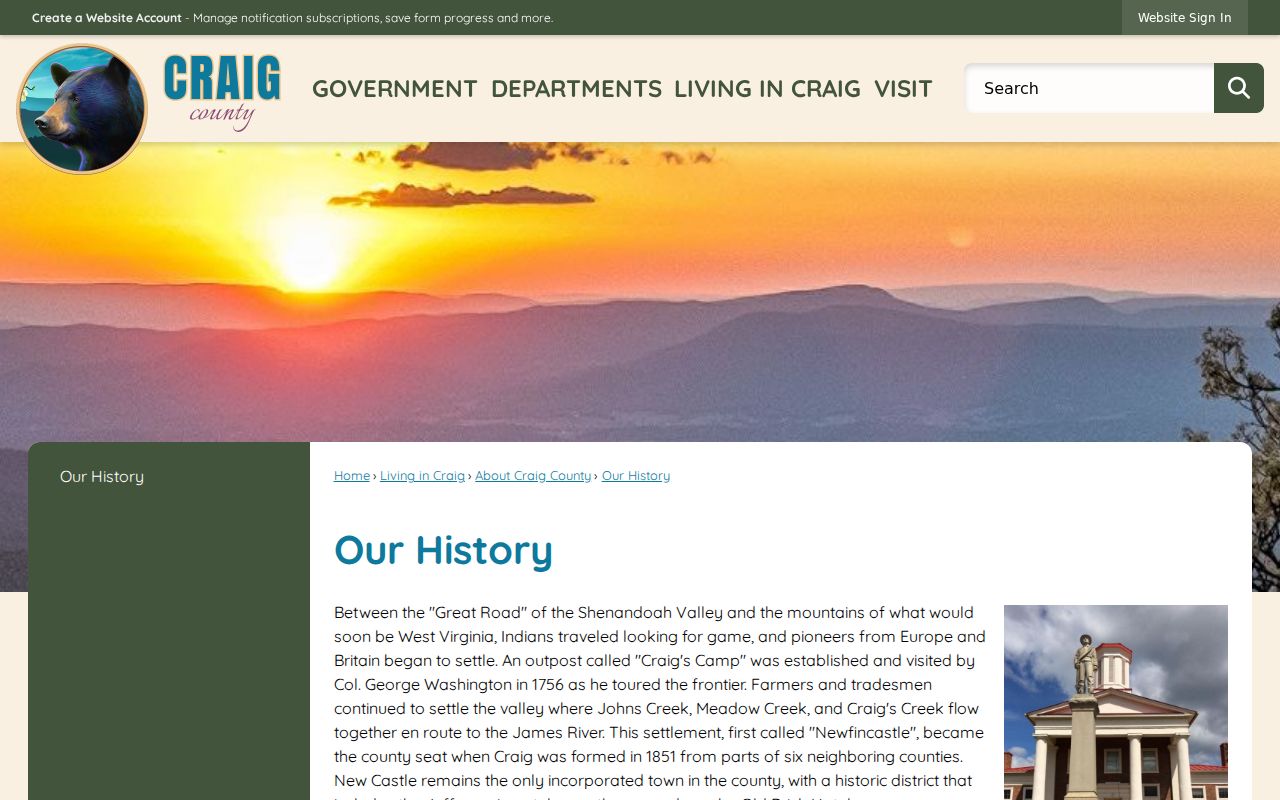
Record the book and instrument number for every link. Note whether each early deed is an original or a later re-recording.
Before 1851, Craig County Was Not Yet Formed
Craig County was formed in 1851. Its land came from Botetourt, Giles, Monroe, and Roanoke, plus later adjustments with adjoining counties. A transfer predating countyhood may sit in a parent jurisdiction's deed books instead. New Castle's town plan dates to 1818, when the area still belonged to Botetourt County. Before searching any index, identify the historic jurisdiction at the time of the transaction.
Orient the tract with its current legal description and GIS map location. Then hunt the predecessor deed in the correct earlier county. Boundaries shifted repeatedly. So a modern Craig County address guarantees nothing about where an old instrument was filed. When the jurisdiction stays unclear, the Clerk or the Library of Virginia can help. Either can point to the right catalog series for the parcel.
Step Back Through Craig County Deeds
Open the latest deed on the Craig County parcel. Read the grantee, grantor, instrument type, date, and legal description. Search that grantee backward as the buyer in the prior deed. The seller there is the grantor. Repeat until the deed index runs out, then shift to the books and microfilm. The Clerk publishes no online cutoff. Ask the office or use the LVA catalog to pick the next year range. Guessing an arbitrary stop date can break the chain of former owners.
- Find the latest recorded deed and confirm that its legal description matches the parcel.
- Record the grantee, who is the party receiving the interest.
- Use the grantee's name to find the prior deed, where that party appears as grantor.
- Continue with both party indexes, checking spelling and book references at each step.
- At the web-index limit, continue through the 1851-1912 LVA indexes and referenced deed books.
- Grantor
- The party conveying the interest.
- Grantee
- The party receiving the interest.
- Chain of title
- The linked sequence of transfers recorded for the land.
- Legal description
- The written land boundary used to match older records when street names change.
Craig County Chancery Adds a Parallel Chain
Not every former-owner story reads as a tidy run of sale deeds. Craig County chancery causes sit at the Library of Virginia. They cover land-development companies, railroad-era ventures, partitions, and fights over debt. A chancery file can explain why a parcel changed hands. It may show how an heir's share was settled. It may also reveal why a subdivision never got built. Think of it as narrative court context sitting beside the deed index. The C&O Craig Valley Branch reached New Castle in the 1890s. Bank Square lots then sold and developed along Main Street through the 1920s. Reconstruct that era by pairing a chancery cause with its recorded plat and conveyances. One caution applies. A case file alone does not prove a company owned a lot. Match parties and the legal description to the land records first.
Craig County Estates Can Explain Prior Owners
Death often explains a gap in ownership. When a Craig County property passed through an estate, an executor's or administrator's deed records the legal transfer. The probate file shows who held authority to sign it. The Clerk handles probate and estate matters. LVA lists will books from 1851 onward in several runs. A fiduciary register covers 1864 to 1888, and settlements run from 1973 to 1979. Those estate files add the human story behind an otherwise short conveyance entry.
Other record series can matter as well. Craig's LVA finding aid includes judgment-lien dockets running from 1878 to 1967. A release deed book spans 1884 to 1894. Neither is a standard owner-transfer sequence. Yet each can reveal a claim against the property or its later discharge. A name appearing in both a deed and a lien docket deserves care. Keep each instrument type distinct when you write the property history.
Craig County Former-Owner Research Can Use Family Leads
Estate deeds often name unfamiliar relatives. Those names can open a family lead. LVA's Craig County catalog lists filmed vital registers, and the Virginia Department of Health publishes genealogy guidance for its vital records. Neither source transfers land or proves title. They describe people and family events instead. Anchor every family clue to the executor's deed, probate file, or court order that touched the parcel.
The Virginia Department of Health's genealogy page explains its vital-record research route. Treat it as historical context only, then return to Craig County deeds and probate records to verify the ownership link.
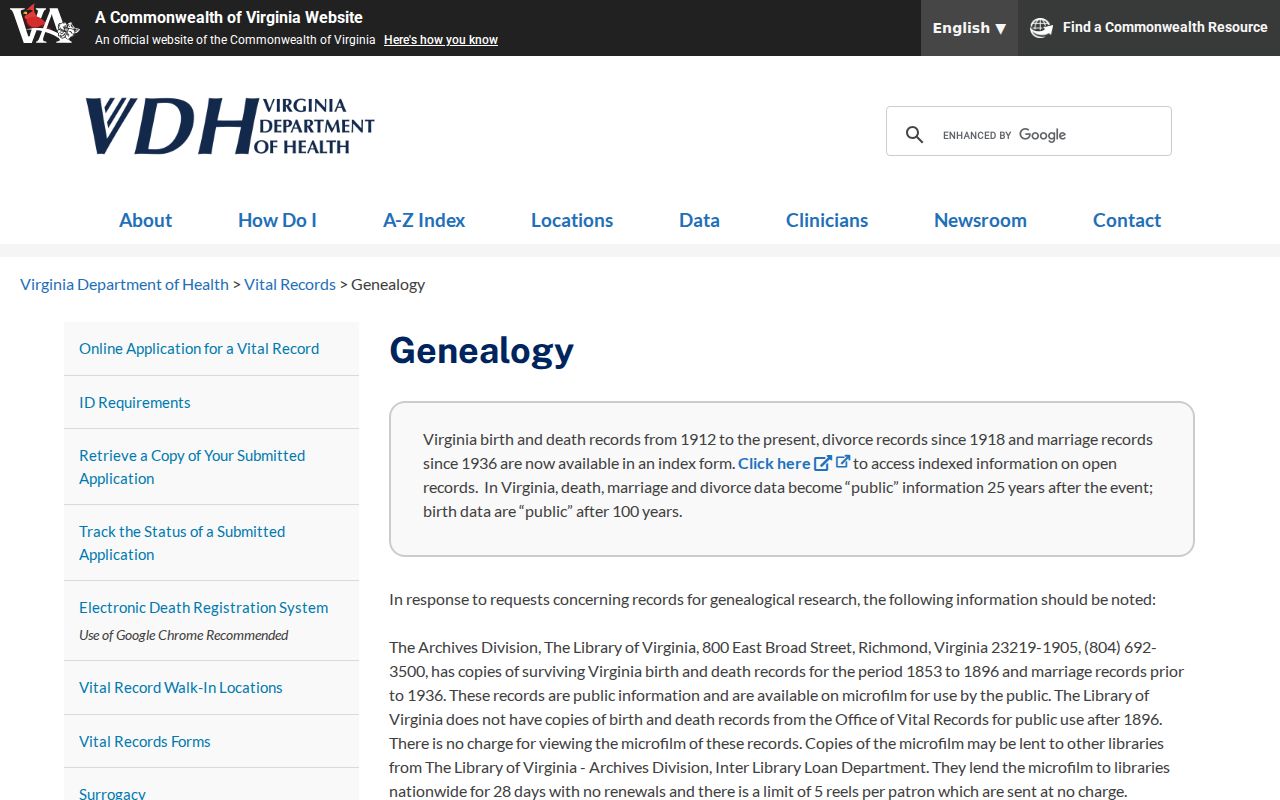
A name alone proves nothing about ownership. In Craig County, a recorded deed, probate authority, or court order must connect the family lead to the parcel before it belongs in the property history.
How Far Back Craig County Ownership Records Go
Craig County ownership paper reaches back to 1851. The Library of Virginia documents grantor and grantee indexes covering 1851 through 1912 and a plat book spanning 1851 through 1932. Deed Book A was destroyed. Books B and C preserve re-recorded early deeds, so much early land activity survives in copied form. The online index states no earliest year. The finding aid omits the full land-book run. A chain of title may still reach deeper through courthouse books, parent-county records, probate, or court files than an online property search suggests.
Research limit. Use former-owner records for a property's title history, maintenance, or documented local history. Do not use a chain search to track or harass a living person. A current title question belongs with a title professional; the Craig County current-owner record page covers present ownership confirmation.