
Craig County Deed Records and Instrument Types
Deeds and other real-estate documents in Craig County are recorded by the Circuit Court Clerk. The office does not spell out a full list of instrument types in its public materials. Even so, a few categories come up again and again in land records. A deed passes an interest in land. A deed of trust secures a debt. A release or satisfaction shows that an old security instrument was paid off. It also shows the debt was cleared. Plats, easements, judgments, and liens can also appear alongside the conveyances. Those conveyances make up a parcel's paper trail.
| Deed Type | What It Does | Common Use |
|---|---|---|
| General or special warranty deed | Conveys the grantor's described interest, with warranties varying by form | Review the operative clauses and legal description |
| Quitclaim deed | Transfers whatever interest the grantor has, without a promise of title | Related-party or title-cleanup transfer |
| Deed of trust | Creates a security interest tied to a loan | Check for a later release or satisfaction |
| Executor or trustee deed | Transfers property under fiduciary authority | Pair with the probate or court file |
| Release, easement, or plat | Changes a lien, use right, or mapped land description | Read with the deed and parcel map |
Not every instrument in a Craig County deed record search is a sale. A deed of trust names the same land but conveys no ownership to the lender. A judgment lien or an easement touches the parcel differently too. Before concluding a transfer occurred, read with care. Check the document type, the party roles, the recording reference, and the legal description.
Craig County SRA Separates Index from Image
Virginia Secure Remote Access puts circuit clerks' land records online through a system called COVERS. The statewide courts page posts an Available Courts list. That list shows which clerks allow free index-only access. An index hit is not an open image. Full image access takes local clerk authorization, a signed subscriber agreement, and applicable fees. Craig County's public pages name no starting year or current image price. Confirm availability with the Clerk first. Do not rely on a remote-only search of Craig County property records. The Virginia Courts SRA overview explains the access split. For a Craig County deed, use the index as a locator. Then confirm the image route or request a copy from the Clerk directly.
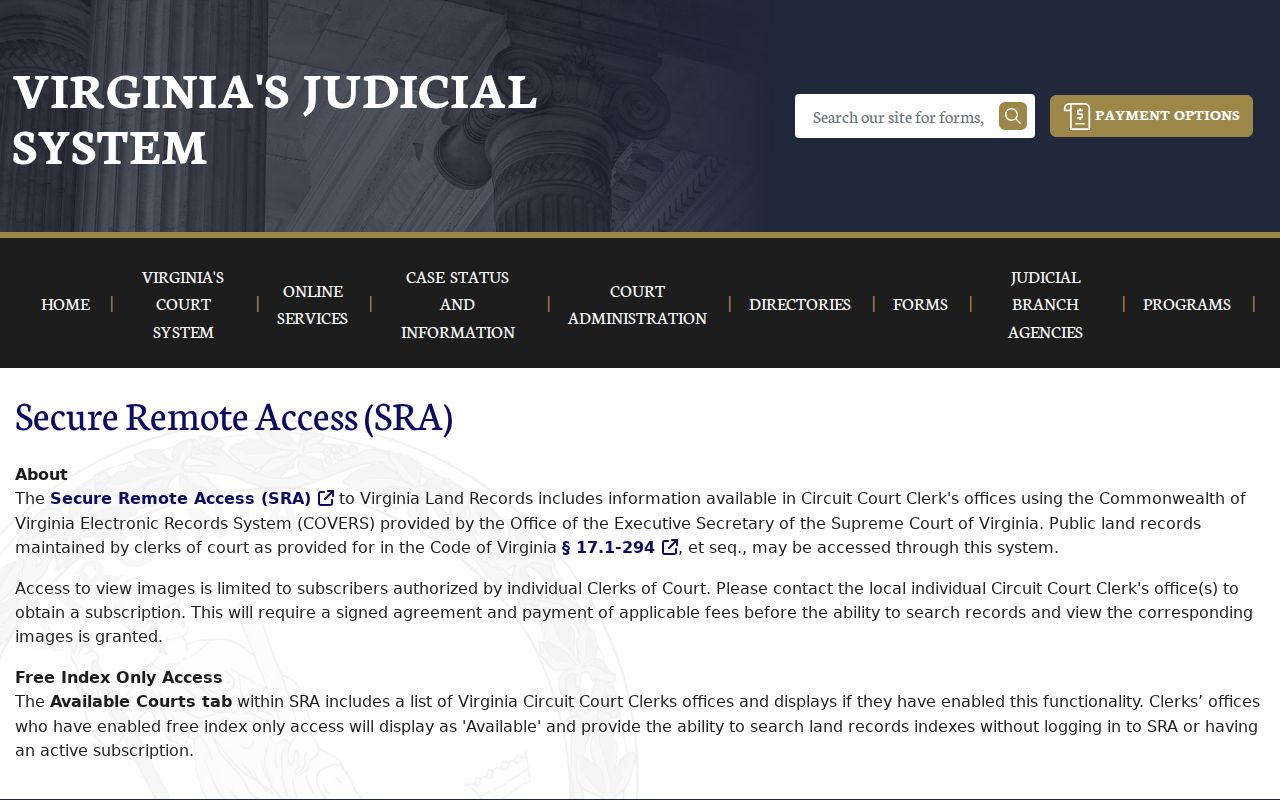
Index access helps with names and recording references. The instrument image is what you need to read the operative clauses and legal description.
Craig County Deed Book A Has a Civil War Gap
Craig County formed in 1851, and its earliest deed trail bends around a courthouse destruction. General David Hunter's 1864 passage burned Deed Book A and most loose papers. The county's own history and the Library of Virginia finding aid both describe the loss. Book B begins in 1864, yet it holds re-recorded deeds dating back to 1851. Book C carries more early re-recordings. So a missing original page does not make the transfer unknowable. An old chain may stop at the gap. Check re-recordings and deed indexes. Land books and court orders help. Chancery causes, probate files, and plats add more clues. Craig County's history page describes the courthouse record loss. The Library of Virginia finding aid separately identifies surviving deed books. It also lists reel locations for anyone tracing Craig County deed records.
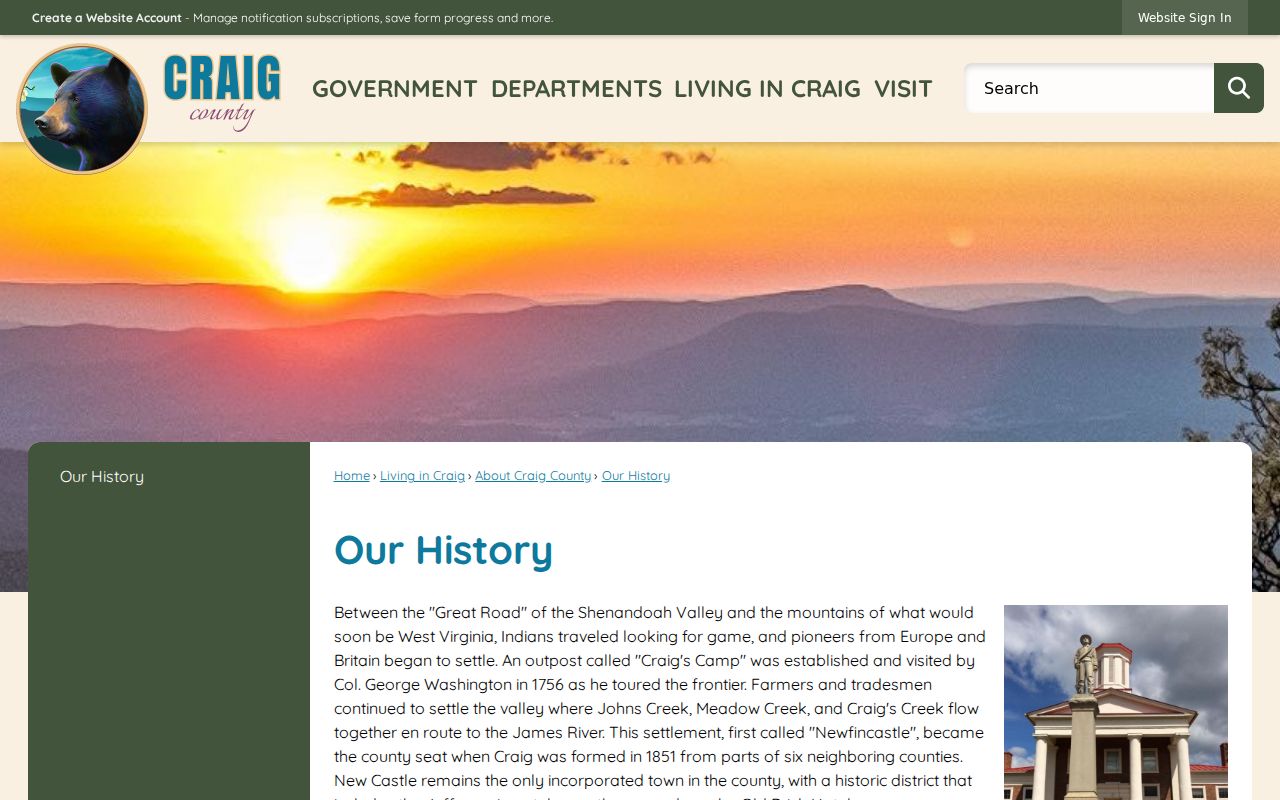
Later copies make source comparison matter. Note whether an entry is an original deed, a re-recording, or a later court-based transfer.
Craig County Deed Search Fields Need Verification
The county's public pages name the Clerk as custodian of real-estate documents. They do not spell out the live search form. The screen may or may not label parties as grantor and grantee. Selectable document types, date ranges, book and page boxes, and sort order all remain unconfirmed. Never assume menu names from another Virginia locality match Craig County. Use the SRA portal to view the current controls. Contact the Clerk if a party search does not resolve the deed record you expect. For each candidate deed, note the party names and roles. Also note the instrument type, recording date, book and page or instrument number, legal description, parcel reference, and any image link. A careful search note separates confirmed fields from those inferred from general land-record practice.
Craig County's Grantor and Grantee Trail
Every deed names two sides. The grantor transfers an interest in land, and the grantee receives it. Begin with a deed you already hold. Find the grantee named there. Then search that person's name as grantee in the earlier Craig County deed that brought the parcel to them. Work backward one recorded transfer at a time. Names trip people up, because clerks abbreviated freely or spelled one family several ways. Check both the grantor and grantee indexes. Match the legal description rather than a name alone.
For every link, keep the recording date, the names, and the book or instrument reference. A release, correction, trustee deed, or estate conveyance may explain why the next entry does not look like a normal sale. Compare parcel clues across the papers too. Older instruments often describe land by a road, a creek, an adjoining owner, or a metes-and-bounds call instead of a street address, so compare land descriptions carefully. If two Craig County deed records conflict, note it and ask the Clerk or a title professional which instrument controls.
- Locate the newest deed that names the current grantee and the parcel's legal description.
- Read the grantor name and the prior recording reference from that instrument.
- Search the prior owner as grantee, then verify that the land description matches.
- When the web index ends, continue through the county books and Library of Virginia microfilm.
- Grantor
- The person or entity conveying the interest.
- Grantee
- The person or entity receiving the interest.
- Chain of title
- The linked sequence of recorded transfers for the land.
- Legal description
- The deed's written land description, which must be compared across older records.
Craig County Indexes and Plats Have Known Years
The Library of Virginia catalog gives firm historical ranges the online portal does not. Grantor and grantee indexes span 1851 to 1912. The plat book covers 1851 to 1932, pages 3 through 74. Release deed book 1 runs 1884 to 1894. Judgment-lien dockets stretch from 1878 to 1967. Each Craig County record answers a different question, so a deed chain may need both the transfer indexes and a plat or lien source.
| Craig series | Years listed | Why it matters |
|---|---|---|
| Deed Books B and C | 1851-1884, with early re-recordings | Surviving early county transfers |
| Grantor and grantee indexes | 1851-1912 | Party-based chain search |
| Plat Book | 1851-1932 | Subdivision and parcel descriptions |
| Judgment-lien dockets | 1878-1967 | Parallel claim history |
The LVA catalog lists film reels and record spans for Craig County. The catalog view appears below, and a tract predating the county may also require a search in a parent county's deed records.
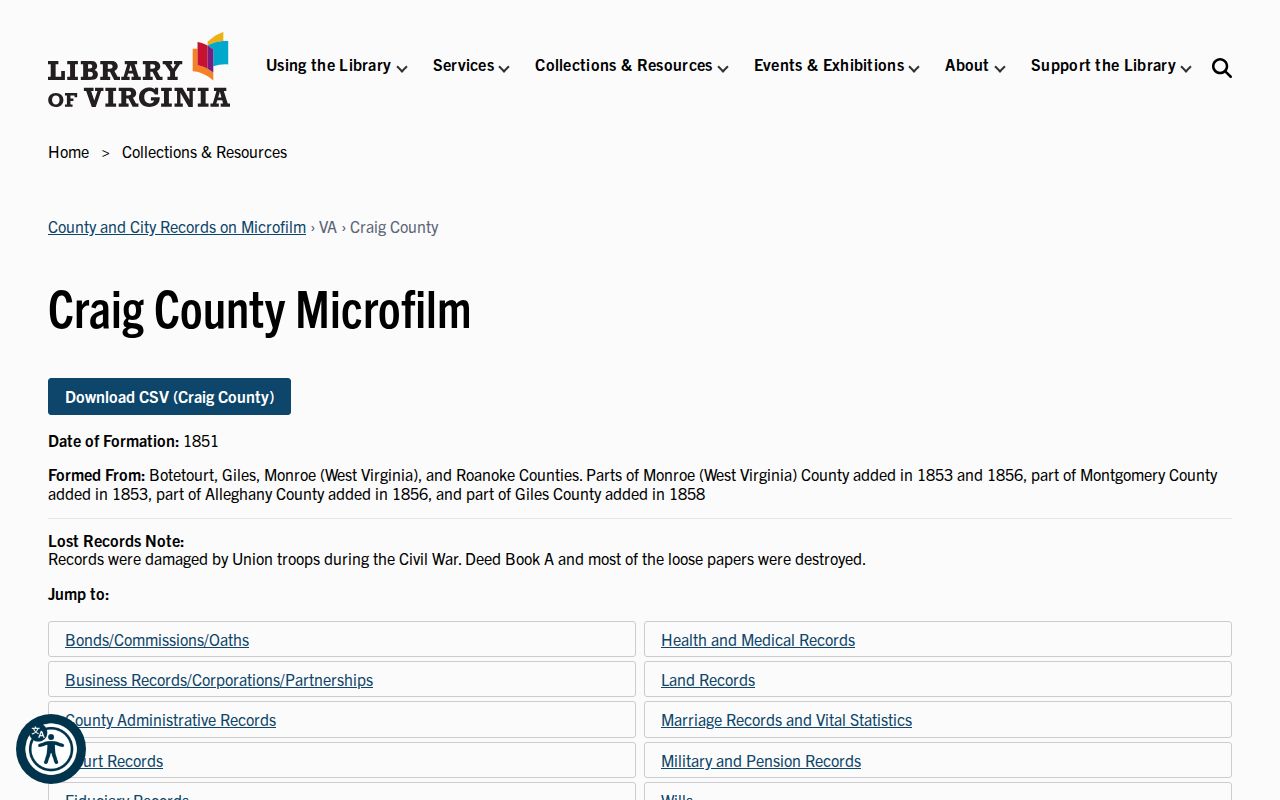
The finding aid points to the right volume. Use it whenever a modern SRA result stops short of an older Craig County transfer.
Craig County Land Records Include More Than Sales
A Craig County deed book holds more than sales. Legal events can change how land is used or burdened without any standard sale taking place. Look for deeds of trust and their later releases. Rights of way, easements, plats, and trustee deeds appear in the same deed books. Mechanic's liens and judgment liens show up as well. Executor and administrator deeds turn up too. The LVA finding aid lists judgment-lien dockets and a release deed book separately from the deed records. An encumbrance is a claim or right affecting land. Such a claim does not automatically pass ownership to anyone. Death often explains a strange signature.
A probate file can show why an executor or commissioner signed a deed, who held authority, and how heirs split the land. Craig's historic will books cover several eras, and the finding aid describes a general will index for 1850 to 1893 under a misleading “Index to Deeds” label. For a puzzling estate conveyance, check both the land instrument and the probate index rather than treating a terse deed entry as the full story.
Requesting a Craig County Deed Copy
Before contacting the Circuit Court Clerk for a deed image, gather the key details. Note the parties and the recording date. Include the book and page or instrument reference as well as the legal description. The Clerk's official page states that office-made copies carry a charge, though it gives no current per-page price. SRA image access depends on clerk authorization. Ask for specifics. Find out whether a plain or certified copy is available, what fee applies, and whether the office handles requests remotely or in person. The Clerk is at 182 Main Street, Suite 4, New Castle, VA 24127, and the phone number is 540-864-6141. Identify the actual instrument in any copy request. Rural addresses and older tract descriptions can be ambiguous, so a request that says only “the deed for this address” may not be enough. A prior conveyance reference helps too. The Craig County former-owner chain method shows how.
Recorded, not guaranteed. A Craig County deed index identifies filed documents but does not prove that no other interest or defect exists. Use a qualified title professional when clear ownership must be established.